

East and northeast flanks continue to be focus for White Rock Lake firefighting efforts
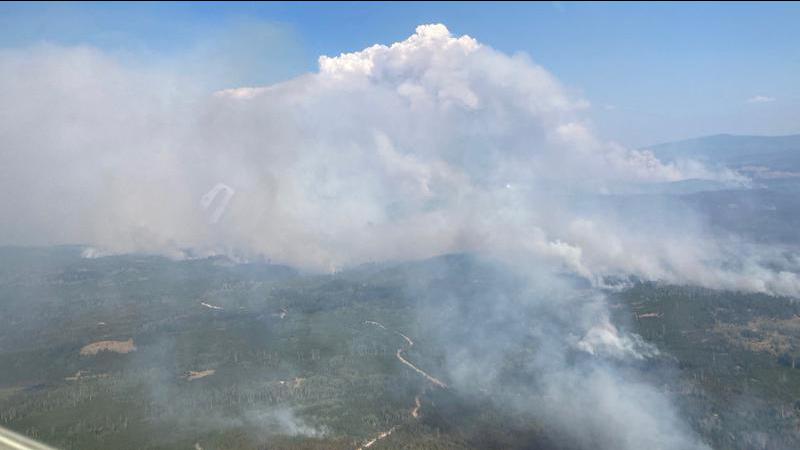
While crews have been dispatched to tackle the White Rock Lake wildfire on all fronts, the east and northeast flanks continue to be the areas getting the most focus.
The B.C. Wildfire Service said crews and equipment are working to defend pre-established containment lines above communities and structures along the eastern perimeter of the blaze. Structural protection crews are working to hit hot spots while also mopping-up around impacted areas.
Heavy equipment crews are working to re-establish the Terrace Mountain fire line from 2009 and tie it into the pre-established guard at Stuart Lake.
“In 2009 there was a wildfire which we can use today as an anchor point of an area that is going to see diminished fire activity naturally because there was a burn there,” said Fire Information Officer Carolyn Bartos.
“It’s just looking at the landscape and utilizing what’s on the land to put those containment lines in and establish containment lines on the current wildfire off of areas that make sense, and this area makes sense to establish a containment line.”
Aerial resources, including bucketing helicopters, are supporting the efforts on the ground by hitting hot spots.
Along the northeast flank, south of Glenemma, crews used hand ignitions to secure a containment line along the perimeter near Irish Creek Road and Westside Road Thursday night. Heavy equipment is being used Friday to construct a guards going west from Irish Creek and going east from Cedar Creek. Guards are also being constructed between Irish Creek and McGregor Creek.
While the fire is still active on the other flanks, there has been no expansion beyond fire guards in the past 24 hours. There are firefighters still deployed to all but the southeast and west flanks, which are being monitored by aerial resources in case the containment is breached.
In total, 278 firefighters; 88 structural protection personnel, including 20 who remained on sit through the night; 13 helicopters; 16 danger tree assessors/fallers; 102 pieces of heavy equipment; a B.C. Wildfire Service Incident Management Team; and additional staff are tasked with fighting this fire.
The size of the fire is still estimated at 81,139 hectares, and is roughly 10 kilometres west of Vernon.
In the meantime, the forecast for a bit of precipitation over the weekend is a welcome prospect for the firefighters, though it would take a significant amount to have any serious impact on the fire.
“We do see a little bit of diminished fire activity even in the recent days when we did get a little precipitation that did hit the ground, however, we do need a lot more to actually make a difference,” said Bartos.
“But it is in the forecast and our weather window of extreme burning through those hot days seem to be going down as the weather is approaching more of those kind of fall conditions. But we still have a little bit of a ways to get there before that happens.”