Safety and efficacy of COVID-19 vaccines for children topic of virtual town hall
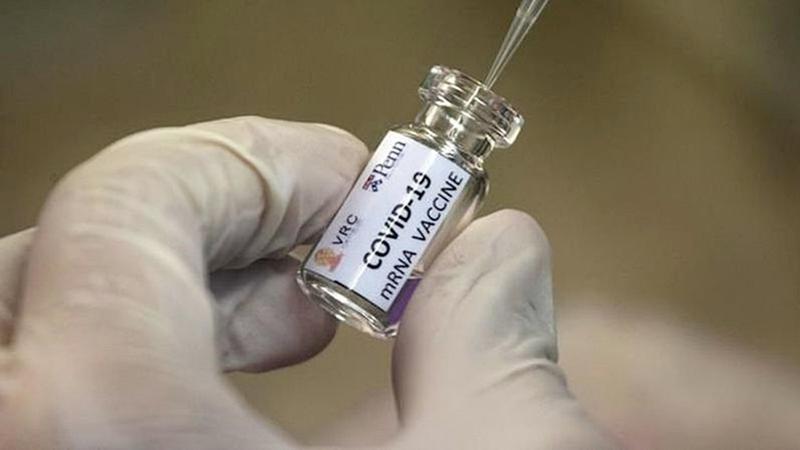
A Canadian-based initiative to dispell myths and provide education on COVID-19 will host a virtual discussion on children’s vaccinations.
ScienceUpFirst, which is comprised of researchers, doctors and scientists from across Canada, will hold the Kids & Vaccinations Town Hall on Thursday, Jan. 27 at 5 p.m.
Dr. Manish Sadarangani, the Director of the Vaccine Evaluation Centre at B.C. Children’s Hospital and an associate professor in the Department of Pediatric at the University of British Columbia, will be one of the panelists at the town hall.
Sadarangani told Vernon Matters the panel will speak about and answer questions pertaining to COVID-19 vaccinations for children, with a particular focus on children aged five to 11.
“I think it’s a very unique age group, and as a pediatrician, I really like working with kids obviously, and I think because they are not able to essentially consent on their own behalf and their parents need to consent for them, it just creates an extra layer of issues that are not there in adolescents and in adults,” said Sadarangani.
“So really, the purpose of the town hall is to really bring people together who will be able to address and answer the key questions from the kids themselves as well as their parents and care givers and other people who are having to educate those groups about vaccines and about COVID-19.”
Sadarangani will be joined by Dr. Christine Chambers, PhD, who works in the field of vaccines and pediatric research, and has focused on addressing the pain and anxiety of needles, even starting the initiative It Doesn’t Have to Hurt; Dr. Katharine Smart, who leads the Canadian Medical Association and is also a pediatrician; and Dr. Nisha Thampi, a pediatric infectious disease physician.
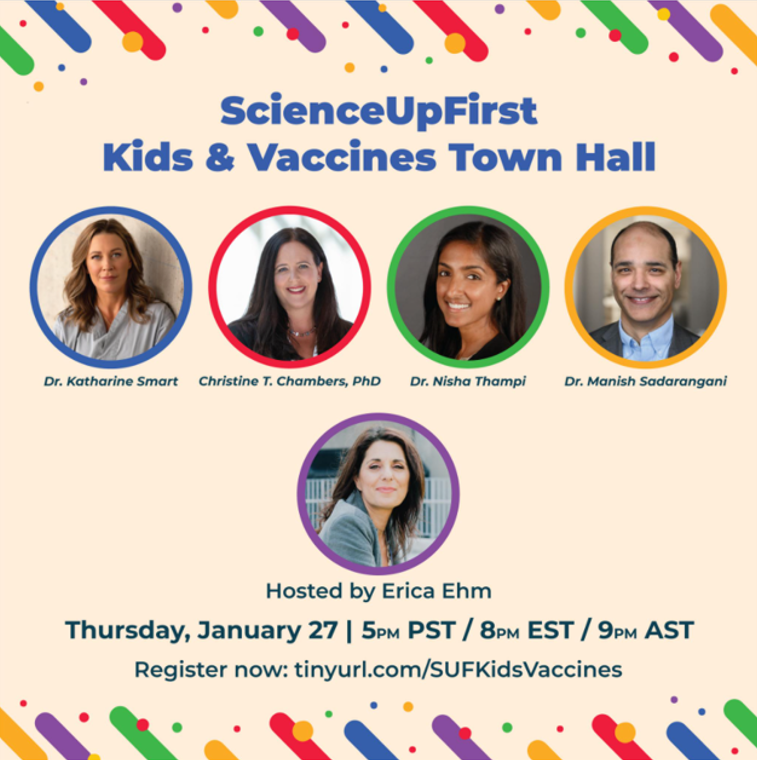 The panel participating in the ScienceUpFirst Kids & Vaccines virtual town hall (graphic courtesy of ScienceUpFirst)
Together, the panel will address a number of questions and concerns that parents and guardians have surrounding vaccines for children, such as confidence in the vaccine.
“[I hear] concerns from parents that the vaccines have not been adequately tested in children and they want more information around the safety of those vaccines and, in that regard, I would say that even in the last couple of months, we have seen several million children who have received these vaccines in North America, mostly in the U.S. including a lot of children who have received two doses, and up to now, we have not seen any significant safety concern that has been identified,” Sadarangani explained.
He noted that complacency is another key topic to address with people who are hesitant to get themselves, or their children, vaccinated.
“A lot of people think that [COVID-19] is not a severe disease, it’s relatively mild, kids aren’t that badly affected, and I think, especially with the recent Omicron surge, I think almost everyone now knows somebody who has had COVID. And for the most part, for children, that has been a mild illness,” said Sadarangani.
“So then I think it sort of lends itself to the narrative that ‘it’s mild illness in children, it’s not a big deal, we don’t really need the vaccine,’ and part of that is because people are not seeing what myself and my colleagues are seeing, which is, we are seeing kids still in hospital with this disease, as we have seen throughout the pandemic. Not a huge number, but they are there.”
The doctor added that not all infections lead to immediate need for hospitalization, while some can lead to other health complications several weeks later that require treatment, such as multisystem inflammatory syndrome in children (MIS-C).
“Those cases occur, and while they are not common, it’s almost impossible to predict who is going to be that child that gets the severe outcome.”
The town hall is open to everyone, but will mostly be focused on connecting with people who are hesitant of the vaccines.
“We’re trying to provide reliable information for those people who have questions,” Sadarangani remarked, adding that both those who are very for, and against any vaccines for children, likely won’t be tuning into the town hall.
“We’re really trying to target those people who are in the middle who may or may not have got their kids vaccinated but still have a lot of questions or want to get more information and we’re trying to help inform people with those questions.”
Anyone who wishes to watch the ScienceUpFirst Kids & Vaccines Town Hall can register here. Questions for the experts can also be submitted through that portal.