

Canada’s premiers unanimously call for increase in health transfers
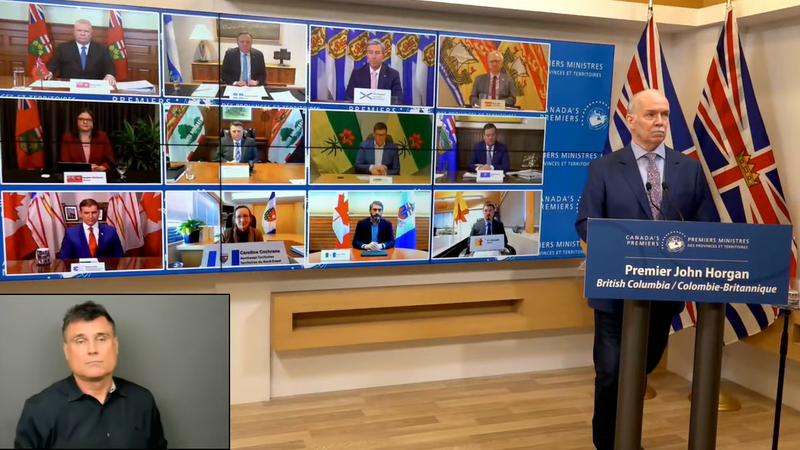
Canada’s premiers are calling on the federal government to increase health transfers.
The feds currently cover 22 per cent of each province’s health care costs, with provinces covering the remaining 78 per cent.
Following the Council of the Federation winter meeting today, all 13 of Canada’s premiers came together to demand the health transfers be increased to 35 per cent.
Council Chair and B.C. Premier, John Horgan, said during a news conference featuring all the premiers, they have been calling for an increase of the transfers for the past two years and it is an urgent need.
“It holds true whether you are facing a global pandemic or not. It holds true more than ever because we know, as premiers, that we have to be accountable for the services we provide, and we need to do that in a way that meets the requirements of the Canada Health Act,” said Horgan.
“When our partnership for public health care in Canada began, it was more or less a 50/50 proposition, but over the past 50 years we’ve seen an erosion of federal funding to the point now where it is, in some cases, only 22 per cent of the total funding needed to provide services. That means the provinces are picking up the rest of that funding, and that is not sustainable.”
Horgan, who has lost 25 pounds since undergoing radiation treatments for throat cancer, added the funding needs to be rebalanced to ensure the critical services that people depend upon can be provided.
“This is about providing services for people. It’s about wait times, it’s about human resources in our health care system, it’s about making sure that we can provide state of the art diagnostics so that we can address diseases as they come forward like COVID-19, like cancers,” said Horgan.
The B.C premier said during his cancer treatment he experienced kindness and professionalism from all health-care staff, but being able to receive that quality of care is not sustainable under the current health transfer model.
“I saw that on the faces of nurses, on doctors, health-care providers, care aids. We need help to be coming on the horizon, and we need that in the form of more funding from the federal government.”
Horgan also noted that they have seen the federal government step up in recent years to help Canadians, whether it be through child care funding or COVID-19 supports for businesses, individuals and communities, and now the focus needs to be on renewing the partnership to support public health care.
Quebec Premier Francois Legault said there were issues with funding health care before the pandemic hit, and since then, there has been even more need for hospital capacity for both COVID-19 patients as well as for Canadians with other medical needs.
He noted that health care is the only service increasing by about five to six per cent each year, saying this is mainly due to the population getting older and requiring more health services. Legault added that these increases put more burden on the provinces, and the federal government needs to step in and provide more financial support.
Legault also asked that the transfers be increased without any conditions.
“It is the provinces and territories who best know where to invest, and what the priorities are,” said Legault.
Building off the point of conditions, Horgan said while Ottawa has a part to play with predictable and sustainable funding and maintaining public health standards, the provinces are responsible for the delivery of the services.
“The needs in New Brunswick are not the same as the needs in Saskatchewan,” Horgan remarked.
“Our concerns with tying strings to funding is that it will be focused on what might be the issue of the day, rather than the long term sustainability of our system, whether it be long term care, reducing surgery wait times, human resource issues, hiring more people, making sure they are appropriately compensated. There is a myriad of issues we need to address as we deliver these services.”
The veteran NDP leader added that the provinces tackle these issues by working with unions and work forces to make sure that the services that fit specific jurisdictions and communities are delivered effectively.
Horgan said he has been engaging with the Intergovernmental Affairs Minister, the Minister of Finance and the Prime Minister as is confident they have a way to move forward on increasing the health transfers, though he did not provide any details or a time line for when a First Ministers meeting dedicated to this discussion could be held.
A letter from Canada’s Deputy Prime Minister, Chrystia Freeland, to B.C Finance Minister Selina Robinson, which was posted to the Government of Canada’s website in December of 2021, shows that the federal government would be providing an estimated total of $45.2 billion to the provinces through the Canada Health Transfer in 2022-23, with B.C. set to receive $6.185 billion.