

Impacted residents vent frustrations during online fire meeting
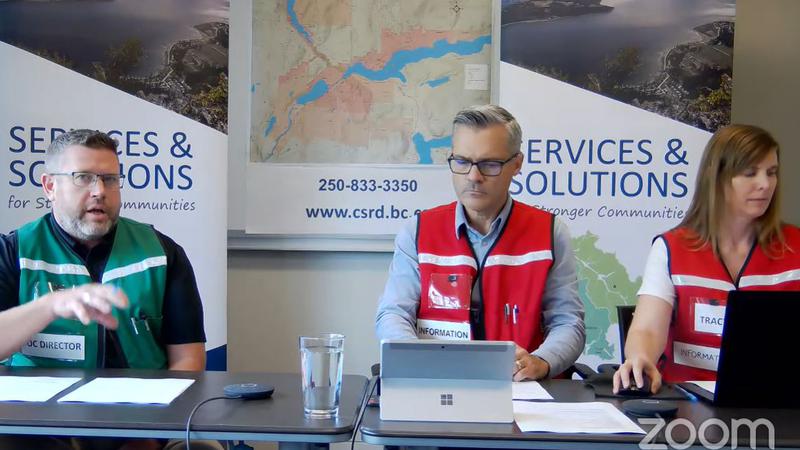
Residents impacted by the Bush Creek East fire got their first chance to ask questions of emergency officials on Friday (Sept. 1), and many were frustrated at still being unable to get back to their homes.
The comments were made during an online community meeting held by the Columbia Shuswap Regional District.
Evacuee Bill Holtby thanked the firefighters, volunteers and others for the work that’s been been done, but wondered when is the soonest evacuated residents may get back in.
“We’re frustrated we’re not getting more precise information,” Holtby said “Will it be two weeks, a month or six weeks?”
Emergency operations centre director Derek Sutherland said they are only getting rough timelines from fire officials, but he’s hoping most of the areas can be back in less than two weeks.
“We don’t have anything specific, unfortunately. I don’t think we’re as long as two weeks away in a lot of our order areas. I’m hoping that we are going to have people back sooner than that, but that’s just a hope and a gut feeling,” Sutherland said.
Sutherland said lifting the orders and alerts will depend on safety factors, such as the fire risk, dangerous tree removal, and getting power restored.
At last update, about 6,800 Shuswap residents were on evacuation order due to the fire with another 5,200 on alert.
Tracey Lorenson told the forum she lives near Adams Lake and has been on alert or order for seven weeks.
“You mentioned that we won’t be off order until presumably the roads are fine, but why not boat access? Move us off alerts so people can boat. Why are we stuck on order? If we were moved to alerts, we wouldn’t have people stopped in boats,” said Lorenson.
Sutherland said the last he heard, the boat launch at the north end of Adams Lake was restricted.
“But we don’t necessarily take into account boat access only, when we’re lifting orders. If the access is safe, then the access is safe,” he said.
Lorenson suggested she is losing patience with the situation.
“It’s been seven weeks since we’ve been put on alert, so three times longer than the others. I’ll be candid: it feels like you’ve just forgotten about Adams [Lake] because the energy has all moved to the north shore. So when can we expect to at least get road access over there because seven weeks is a very long time to be stuck on alert or order?”
“I can assure you nobody has forgot about you,” Sutherland replied. “We’re meeting on your area more than any other area because we know the fire risk in Dorian Bay and Woolford Point is such that we can justify moving it to alert, but the road access is not.”
Earlier in the update, Sutherland said the recovery period from the estimated 170 structures damaged or lost by the fire will be a “three to five year process.”
“We’re not going away any time soon. We’re not going to be finished this work until the last person is helped,” he said.
Plans are being worked out to try and get people back to see their damaged properties before the evacuation order is lifted, which Sutherland called part of the healing process and the closure.
“The team is working really, really hard to try and make that work. It’s logistically incredibly challenging, its still an active wildfire area. There are danger trees and BC Hydro issues, so were looking at bringing people in on a smaller bus [using several buses and coordinating those site visits.”
Mike McCulley, BC Wildfire Service liaison, said there has been very little growth on the fire.
“The update today is relatively calm, not a lot of change on our fire for several days now. We had a wind event a few days ago that we were prepped for. We took significant rain on some portions of our fire, well over 10 mm,” McCulley stated.
The information officer said the fire size is still around 43,000 ha. with some growth by Sorrento earlier this week when it came very close to some properties.
“Other that that, this fire has held in place for the most part.”
McCulley said a ground crew of about 330 personnel are working on the fire which he said includes up to 30 local residents who took training and are helping out.
“It varies day by day [the number of locals]. Anywhere from 10 to 30 on any given day. That’s just the ground crews. That’s hard to track as we’ve given them the purview to come and go as they can.”