

Campaign looks to subdue rising fire deaths

The B.C. government is launching a new safety campaign to deal with an alarming trend of increasing fire-related deaths in the province.
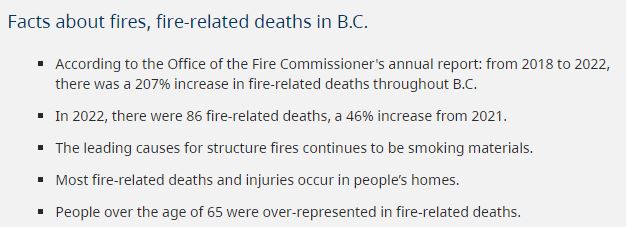
In its annual report for 2022, the Office of the Fire Commissioner (OFC) said there were 9,087 fires last year resulting in 212 injuries and 86 deaths. The fatalities were up 46 per cent from 2021.
The types of fires in last year’s total included outdoor (51 per cent), structure (36 per cent), vehicle (13 per cent) and person (0.5 per cent).
The report stated a working smoke alarm was present at only 45 per cent of the reported residential structure fires.
 (Image credit: Province of B.C.)
In response, the province is providing $1.6 million for a social marketing project to help educate people about proper smoke-alarm use and reducing fire risks.
“We are taking action to overturn the alarming trend of increasing fire-related deaths in our province,” Mike Farnworth, ,minister of public safety and solicitor general. “Once a fire starts, people have very little time to get out of their home safely, making a working smoke alarm a critical tool for saving lives. I’m urging everyone to test their smoke alarms at least once every six months to keep their home and family safe.”
The province has partnered with Statistics Canada to build a Community Fire-Risk Reduction Dashboard. The dashboard provides statistical and geographical information to help B.C.’s fire services identify areas in communities at greatest risk of home fires.
The OFC launched pilots of the dashboard in 11 cities, including Coquitlam, Surrey, Kamloops, Sidney and Port Alberni in July 2022. The dashboard will be rolled out throughout the province in the coming weeks.
Factors contributing to the increasing trend in fire-related injuries and deaths in the province include:
- Demographic shifts—increase in population, aging population, and immigration.
- Increase in homelessness—increase in the number of encampments in many communities.
- Changes in land use—increased development and population density in rural areas.
- Changing technology—Increased use of rechargeable (e.g., lithium-ion) battery powered consumer products and improper charging of those devices within homes.
- COVID-19—More people are working from home and at home for longer periods, resulting from an extension of COVID work-at-home arrangements.