

Province rolls out new COVID-19 restrictions, plans for enhanced testing
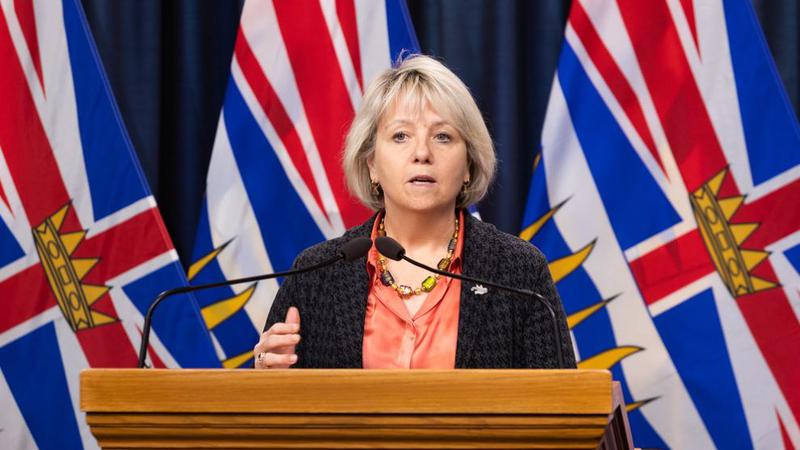
British Columbia has announced new COVID-19 restrictions leading into the holiday season.
The new measures take effect at 11:59 p.m. on Dec. 22 and will be in effect until Jan. 18:
- No indoor organized gatherings of any size (including parties, weddings, etc.)
- Bars, nightclubs closed
- Gyms and fitness centres closed, dance studios closed, sports tournaments cancelled
- Seated events reduced to 50% capacity with vaccination checking and mandatory masking(regardless of venue size)
- Max 6 people per table at restaurants, pubs, cafes, etc. (plus physical distancing or barriers)
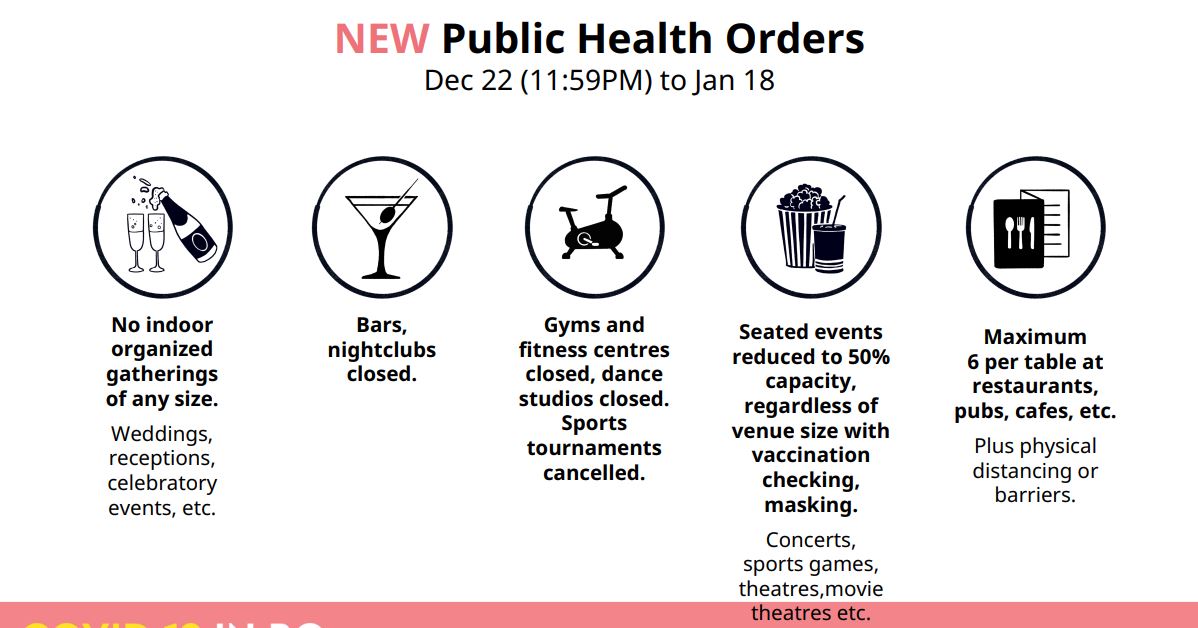 (Image credit: Province of B.C.)
This builds on previous restrictions rolled out by the province that include limiting personal gatherings to the household plus one other household or up to 10 people, and stepping up the verification of B.C. Vaccine Cards.
READ MORE: B.C. bringing in new COVID restrictions effective Monday
The restrictions come as Omicron cases continue to grow across B.C. and all COVID-19 cases continue an upward trend.
“I know on Friday we had conversations. We spoke about the measures that we thought would be sufficient to get us through this, but I can tell you that, over this weekend, we have spent a lot of time understanding as much as we could about what is happening with this variant, how it’s being transmitted in place around the world, and what is happening here in British Columbia,” said B.C.’s provincial health officer, Dr. Bonnie Henry.
Henry noted that, while much is still unknown about the Omicron variant and it’s potential impacts to the health care system, research from around the world has confirmed it is more transmissible and spreads more rapidly than the Delta variants.
“In addition, we are seeing [Omicron] now rapidly replace Delta as the predominant variant we are seeing causing illness here in British Columbia, particularly in the areas that have high populace areas that have had low rates in the past little while in Vancouver Coastal and Fraser Health,” said Henry.
She added that while it’s still unknown how severe an illness the Omicron variant may create, it’s important to take steps to mitigate the potential impact it could have on the health care system, as has been noted around the world already.
“We have seen an increase in hospitalization in places like the [United Kingdom] that are ahead of us in terms of transmission of Omicron, and more recently and closer to home we’ve seen this as well in Quebec, which is very concerning,” said Henry.
B.C.’s top doctor was expecting around 1,300 new COVID cases today, up from the 807 on Monday.
Additionally, Henry stated that there have been more ‘explosive outbreaks’ where more people become infected at the same time and the incubation period shortens, which has also been seen around the world and have put additional strain on their health care systems.
Recent evidence has also found that the Omicron variant has been linked to increased cases where people who had been infected with another strain of the virus becoming ill again. The mutated strain has also caused an increase to vaccinated individuals testing positive for COVID, though Henry said those cases are still well below those that involve an unvaccinated individual.
Minister of Public Safety, Mike Farnworth, said inter-ministry work will continue to ensure these health orders are enforced.
“Given the increases in cases we’re experiencing, we need the public to do everything they can to slow the spread and to avoid any further burden on our health care system,” said Farnworth.
“Compliance with these restrictions is key, and it’s our collective responsibility.”
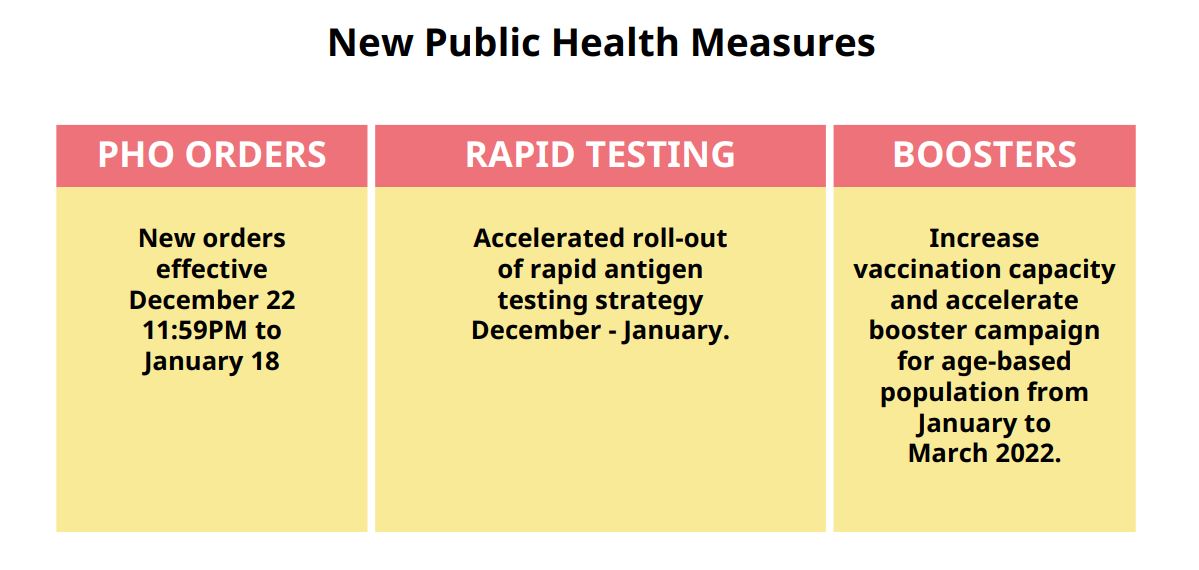 Response plan announced Dec. 21 (Image credit: Province of B.C.)
Additionally, the province is upping it’s COVID testing program.
B.C. is expecting a delivery of 200,000 Panbio Rapid POC tests (nasal swap kits) by Dec. 31, 2021, and other 500,000 BTNX tests with nasal swabs have been purchased and are expected to arrive in the province by the end of the month.
The Canadian government is also expecting to receive 84-million tests from five different manufactures in mid- to-late January. B.C. has requested 13.5 per cent of at least 11-million of those tests.
Of the tests the federal government is procuring, 10-million are rapid tests. It’s not yet known how many of those will be made available for British Columbia.
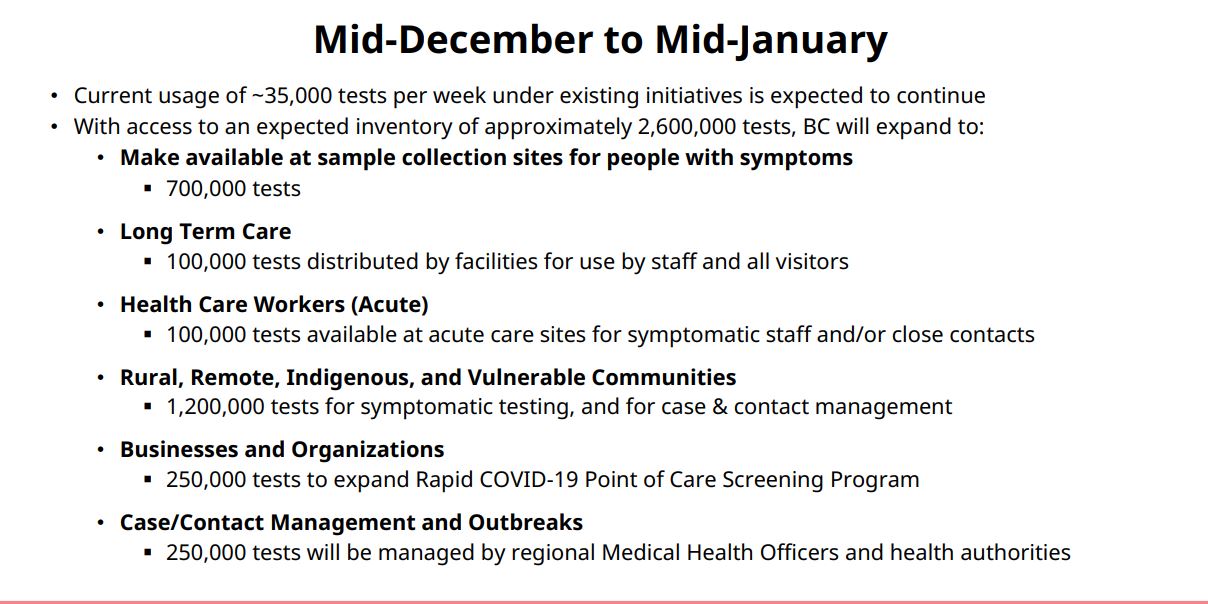 Rapid antigen testing plan (Image credit: Province of B.C.)
To date, 3,197,306 COVID tests have been delivered to B.C. and 1,266,513 of them have been distributed to five key sectors, Long Term Care; Provincial Corrections; Rural, Remote and Indigenous Communities; Case/Contact/Cluster Management; Businesses/Organizations. Approximately 35,000 tests are administered through these channels each week in B.C.
The province plans to expand that testing by mid-January by:
- Making 700,000 tests available for sample collection sites for people with symptoms
- Having 100,000 tests distributed by long term care facilities to staff and visitors
- Having 100,000 tests available for symptomatic staff and/or close contacts at acute care sites
- Having 1.2-million tests for symptomatic testing and case or contact management at rural, remote Indigenous and vulnerable communities
- Having 250,000 tests go towards the expansion of the Rapid COVID-19 Point of Care Screening Program for businesses and organizations
- Having 250,000 tests to be managed by regional Medical health Officers and health authorities for case/contact management and outbreaks
After receiving the approximately 11-million tests from the federal government in mid-January, the province will again expand rapid testing:
- Provide publicly funded tests at additional locations in the community
- Approximately 7-million tests will be reserved for public health and health authorities
- Education (K-12 students and staff)
- 500,000 tests for students and staff to be deployed as needed
- Post secondary education (students, faculty and staff)
- 500,000 tests for rapid testing of symptomatic students, faculty and staff
- Expansion and/or replenishment
- 3-million tests to be used to resupply the aforementioned categories
The expansion of testing through December and January will be continuously monitored to determine the distribution, demand, availability and supply of the tests. This information will be used to determine any additional allocations of rapid tests and modifications in mid- to late-January and into February.
The province notes that rapid tests are intended to add as a supplement and not a replacement to existing testing methods, and results do not reduce or replace the need to take precautions and adhere to PHO orders and guidance.